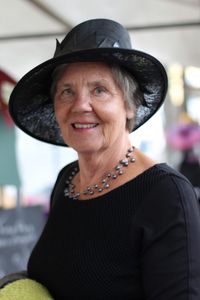
  Marianne Jongkind is a perfectionist and therefore never rests until everything is exactly as she envisions it. For she does not make drawings of her hats beforehand. “Sometimes, when I can't sleep, I make a quick doodle, but as soon as I can, I throw the piece of paper away. There are couturiers who can create beautiful sketches. Frank Govers was one of them; he could capture the essence of his designs with just a few lines.” In 1989, she asked him to design the hat with which she established her name in a wide circle and which would also become her logo: the 'accordion beret'. They were stacked rings stitched together that you could pull out like an accordion. So when you put it on, you could give it all kinds of shapes. And you could lay it flat and put it in your bag like that, very handy. I had actually designed it for my own use. At that time, couturiers started asking if I wanted to make hats for their shows. I didn't have a car, I went everywhere by bike, but of course I still wanted to look good. That hat was the solution. Apparently, more people saw something in it too. At first, I made them in velvet and denim, and later in leather and suede as well. I sell them to this day, and I still wear them myself.” Marianne Jongkind’s career began in 1961, when she was 16 years old. She completed a thorough five-year practical training course at a number of the many hat ateliers that Amsterdam boasted. But in the mid-sixties, the hat industry went into decline. “Dress habits changed. More people could afford a car, and a hat in a car is impractical. But hairstyles changed too. You saw those teased hairstyles, and those didn't go well with a hat either. And the generation gap became more pronounced. A hat represented the established order, and young people rebelled against that. Yet even that young generation wore a hat occasionally: faux fur astronaut caps, some berets, and the floppy hats of Mary Quant, but those were all factory-made hats. The only hats that were still made by hand were fur hats. The Soestdijk princesses wore them too. Beatrix ordered a number of them from Max Heijmans.” For one way or another, Marianne Jongkind had to make hats. That is why she blithely started her own hat atelier in 1967, going against the grain. But around 1985, a counter-movement began as young designers at fashion academies rediscovered the hat. They came from a hatless world and looked at that neglected phenomenon with surprise and interest. That is when I was asked to start teaching. I still mastered that craft—which in their eyes was old—and I was one of the few who had continued with it. During those years, Marianne Jongkind would start making hats for a whole new generation of couturiers: first for Frank Govers, and later for Edgar Vos, Frans Molenaar, Frans Hoogendoorn, and Mart Visser. Edgar Vos and Frans Molenaar have passed away, but she still works for the other two couturiers. And recently, Marianne has had the privilege of working for Ronald van Der Kemp, a couturier with a completely unique approach and dynamic. Through Molenaar, Hoogendoorn, and later Ronald Kolk, she also received commissions for royal hats, such as the Prinsjesdag hat for Princess Laurentien in 2006 and Princess Irene. Princess Carolina even borrowed a purple sinamay hat from her mother in 2005. Marianne Jongkind also built up a large client base of her own. I learned straw stitching in Switzerland; this is done using special machines that are well over a hundred years old and are no longer manufactured. This technique makes it possible to create hats in many different shapes. Her style has naturally continued to evolve. "My designs have become increasingly sleek in line. The spheres are often loose, with usually a point somewhere. No embellishments, no flowers." In the meantime, she has organized quite a few exhibitions of her own creations as an extension of her work. And a number of museums have purchased hats from her. Her style has naturally continued to evolve. “My designs have become increasingly sleek in line. The crowns are often loose, there is usually a point somewhere. No embellishments, no flowers.”
|